Paper strip · hand crank · 30 notes
Music Box
A paper-strip music box for iPhone.
Turn the crank and the paper feeds in; every hole plays a note. Play the twelve tunes in the songbook, punch your own, and send a strip to someone as a link.
Coming to the App Store · iPhone, iOS 18 or later
Play a strip
Für Elise
83 holes · 470 mm · 16 mm/s
Turn the crank clockwise, or press Auto. It only goes forward: going back, your finger slips past the ratchet. This page is silent until you turn it.
Tunes
Twelve in the songbook.
Public-domain tunes, arranged for the thirty notes the box really has. Each is a strip, with its holes and its length. Pick one and it plays on the strip above.
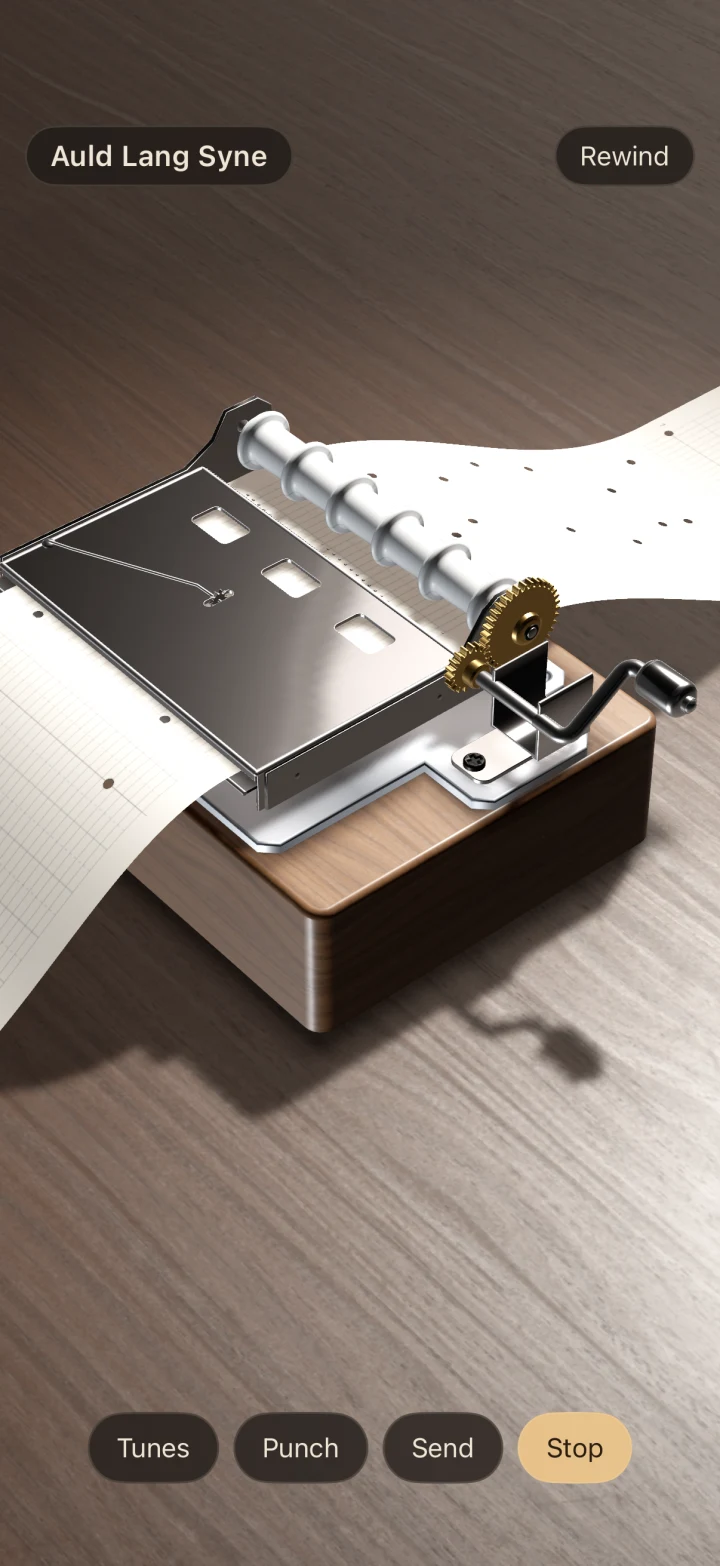
The box
A real movement, to the millimetre.
On the phone, the strip runs through a 30-note hand-crank movement, modelled part by part to the real one’s dimensions: a die-cast base, a mirror cover with three windows, a frosted roller, brass gears and a chromed crank, screwed to a walnut sound box.
The crank turns under your finger. The gears turn with it, the paper feeds in, and each hole turns its star wheel by one tooth as it sounds. The comb stays hidden under the cover, as it does on the real thing.
Every note is made on the phone when the app opens: thirty steel tines, a wooden box and a small room. There are no recordings in it.
- Notes
- 30, from F3 to A6
- Strip
- 70 mm wide
- One step
- 4 mm of paper
- Device
- iPhone · iOS 18
Punch
Punch your own.
Punch draws the strip out of the movement and lays it flat on the table. Tap the grid to punch a hole; hold and slide to aim before you let go. Tap a hole to tape it over. Undo takes back the last punch or tape.
Listen plays the strip where it lies. The title opens the strip’s own sheet: its name, its speed, and where its bar lines fall. Strips you punch stay on the phone, next to the ones people send you.
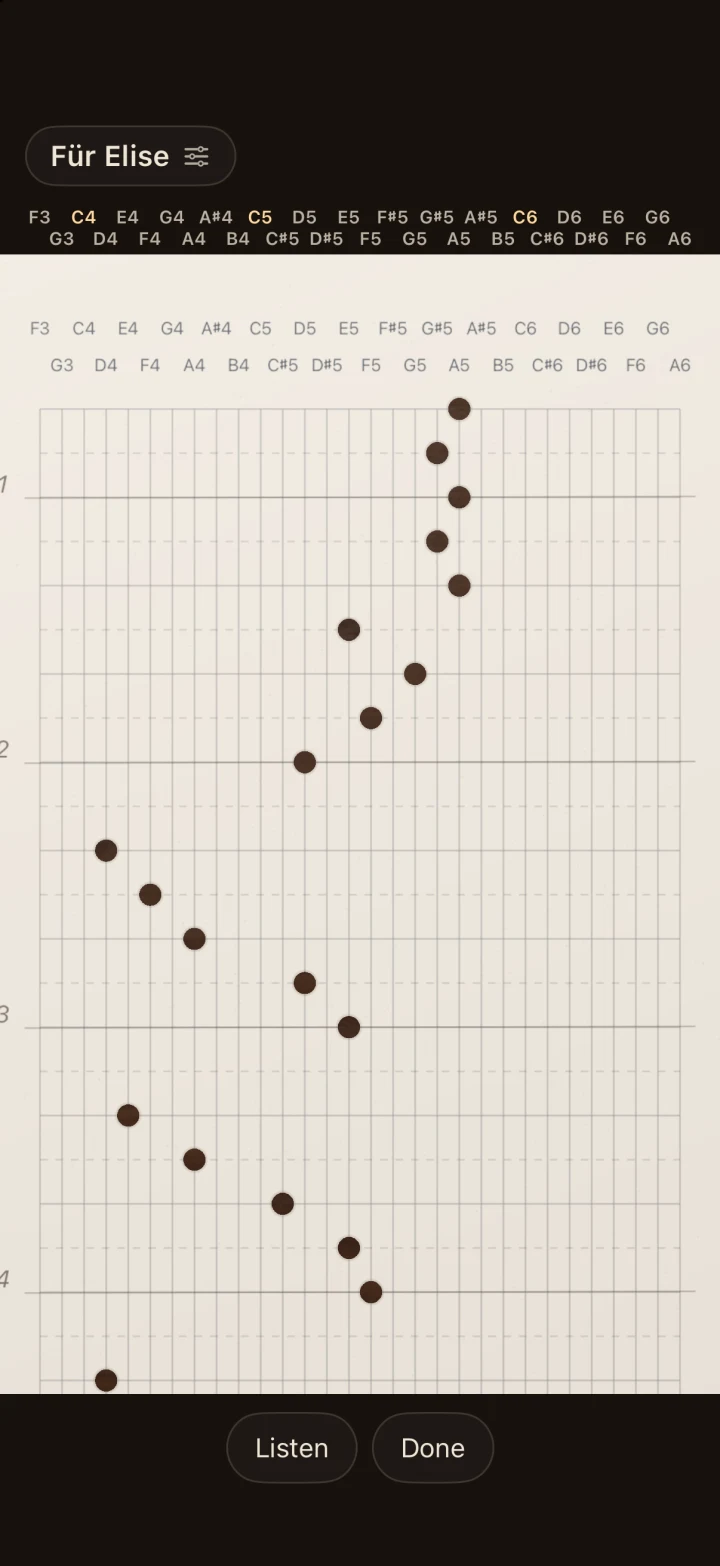
- Note lines Thirty of them, 2 mm apart.
- The same note, 8 mm on The star wheel has reset, so the hole sounds.
- The same note, one step on A step is 4 mm: too soon. The second hole won’t sound, and the app says so.
- Tape A hole taken back.
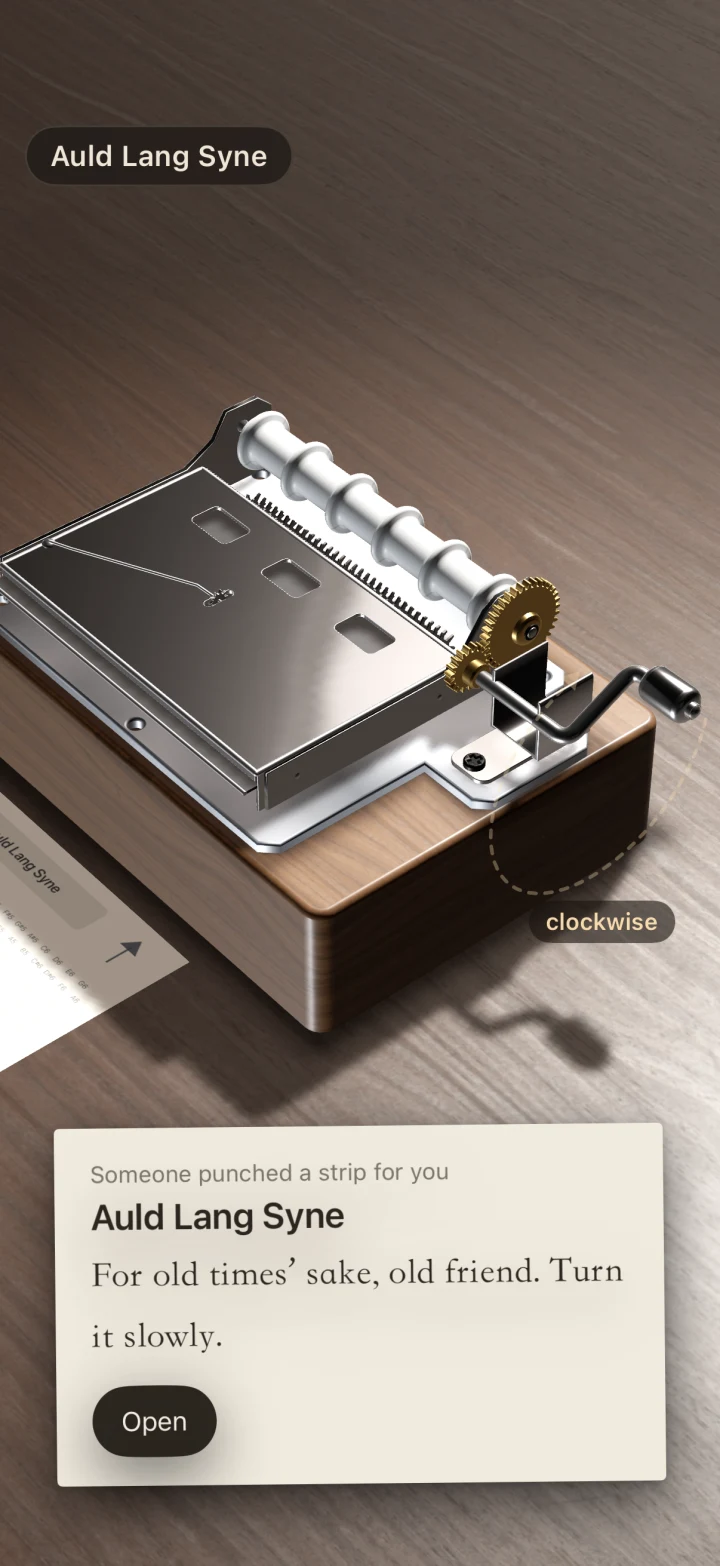
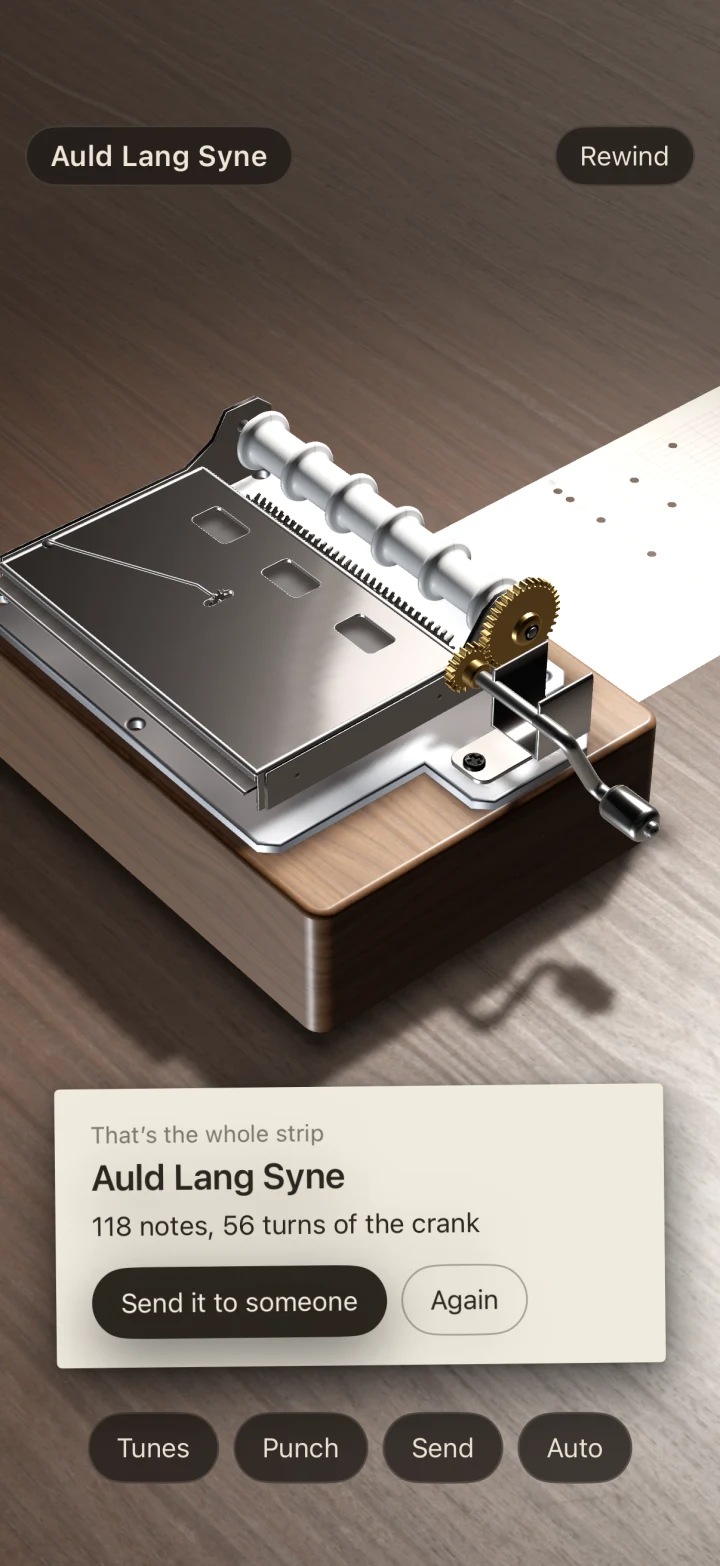
Send
Send it to someone.
Give the strip a title, write a few words, and Send makes a link. The tune and the message travel inside the link, so there is no account, and nothing goes to a server.
In the app, a strip that arrives lies on the table in front of the box, under a card with your words. Open, and it feeds itself into the movement. Without the app, the same link plays in a browser.
https://rubycat.co/products/musicbox/strip/The page. This much reaches the website.
#s=AR4yEAQOQXVsZCBMYW5nIFN5bmUyRm9yIG9sZCB0aW1lc-KAmSBzYWtlLCBvbGQgZnJpZW5kLiBUdXJuIGl0IHNsb3dseS52CoAPgk9HD4ITghGGT0QRhhOAD4JPRxOCFoMYhYiFGIAWglNHE4IPghGGT0QRhhODD4hMQgyECoAPgoeYgBaCU0cTgg-CEYZPRBGGGIAWglNHE4IWgxiFiIUbgBaCU0cTgg-CEYZPRBGGE4MPiExCDIQKgAIHDwThe strip. Everything after the # is read in your browser and never sent.
- title
- Auld Lang Syne
- message
- For old times’ sake, old friend. Turn it slowly.
- speed
- 25 mm/s
- bar lines
- every 16 steps
- holes
- 118, a byte each
Notes
FAQ
For support, email
contact@rubycat.coThe app has no accounts, ads, analytics or tracking, and it collects no personal data.
Read the privacy policy- Where are my strips kept?
- On your phone. The strips you punch and the ones sent to you are listed under Tunes; swipe one to delete it. They are not synced anywhere.
- Do you see the strips I send?
- No. A strip is the part of its link after the #, which browsers do not send to a website. It goes only where you send it.
- Can someone without the app play my strip?
- Yes. The link opens a page that plays the strip in a browser. They can turn the crank there, punch it and send it on.
- Why won’t a note repeat quickly?
- On a real movement a star wheel needs 8 mm of paper before it can pluck again, and the app keeps to that. Give the second hole another step, or put it on a neighbouring note.
- Do the note names match a shop-bought 30-note strip?
- The lines do: the same thirty, in the same places. The names differ. Shop strips are printed from C upward, but the box sounds a fourth higher, and Music Box prints what it really plays, F3 to A6.
- Does it play with the silent switch on?
- Yes, as a music app does.