Live Photos · hand crank · 45 cards
Flipreel
A hand-cranked flip-card viewer for iPhone.
Pick a Live Photo and it is printed as a reel of 45 thick photo cards. Mount the reel and turn the crank: the cards fall past one by one, with the sound they make. Change the paper and the stand, film what you cranked, or hand someone the reel itself.
In development · iPhone, iOS 18 or later
Turn the sample reel
Fred Ott’s Sneeze
Card 1 of 45 · turn 1 of 4
Circle the crank clockwise, tap it for one turn, or press Auto. One turn drops twelve cards. Backwards it runs free, and only the ratchet clicks. This page is silent until you turn it.
How it works
A card bends, slips and falls.
The Mutoscope of 1894 put moving pictures on paper: every frame printed as a card, the cards fixed around a hub like spokes. A stop holds the top card upright. Turn the reel and the card bends against the stop, slips free and falls, and the next one is standing in its place. The Lumières’ Kinora of 1897 brought the same reel to the parlour table.
Flipreel is that machine at the size of a hand. A reel has 48 cards: three dark header cards, then 45 pictures. The crank is geared four to one, so one turn drops twelve cards and four turns play the reel. Stop, and it holds on a card for as long as you like.
The sound is made as you turn, a snap as each card lets go and a tap as it lands, and you feel each card in the hand. With the silent switch on, you only feel them.
- The stop Holds the top card back until the reel has turned far enough for it to slip under.
- The standing card The one you are looking at. It stays for as long as the crank is still.
- The reel 48 cards on a hub. Each is 80 × 60 mm, of stock 0.35 mm thick, with rounded corners.
- The crank Geared four to one: a turn of the crank is a quarter turn of the reel, twelve cards.
- Reel
- 45 pictures, 3 header cards
- Card
- 80 × 60 mm
- One turn
- 12 cards
- Device
- iPhone · iOS 18
Make a reel
A Live Photo, printed as cards.
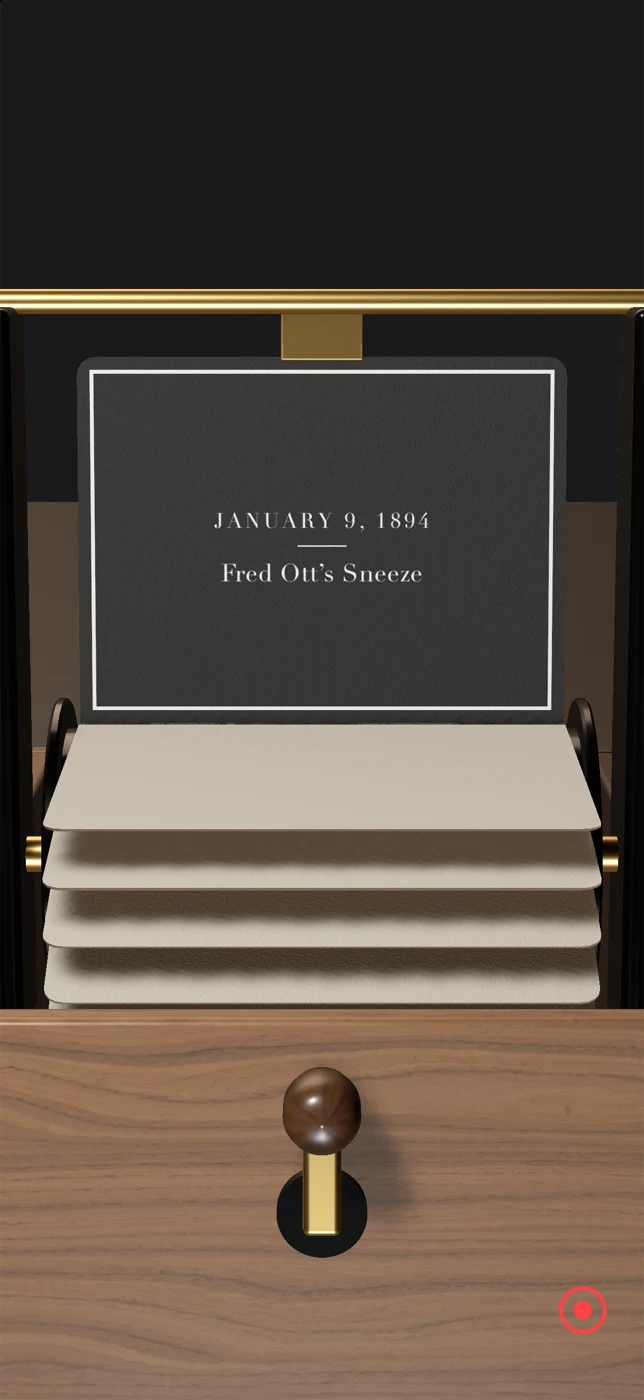
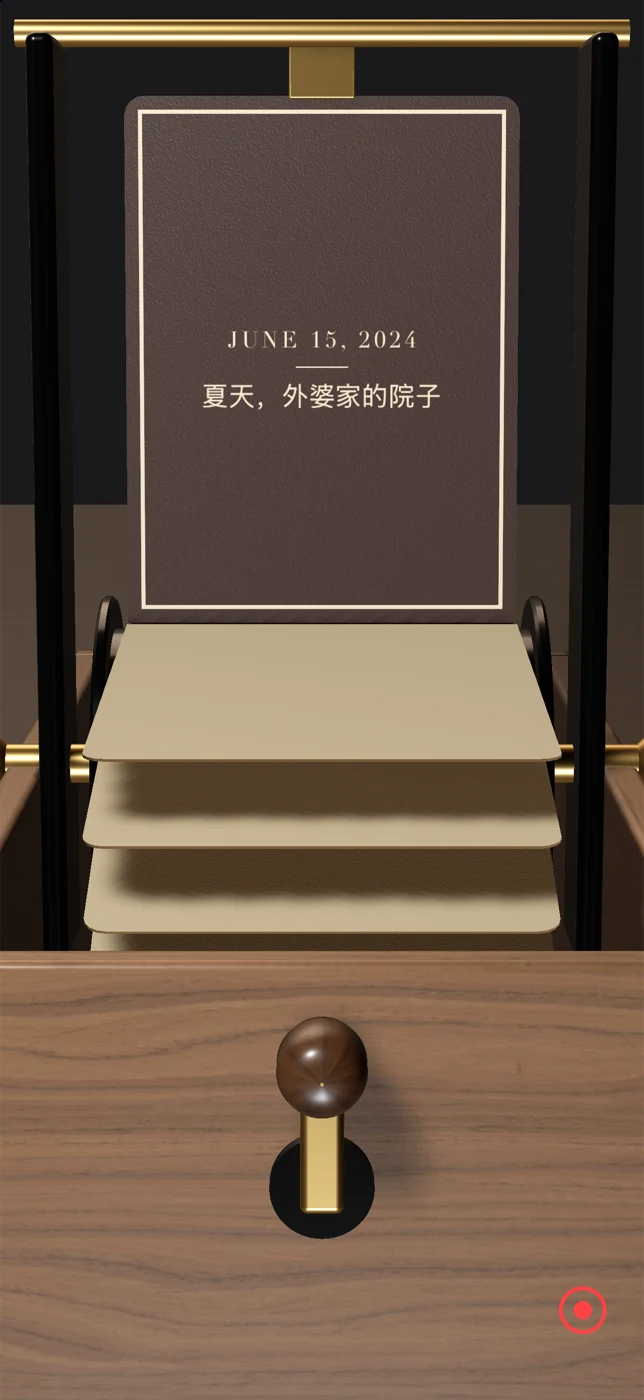
Pick a Live Photo, and the moment around the shutter is printed as 45 cards. A photo taken upright goes on upright cards, one taken sideways on wide cards, and the machine takes either.
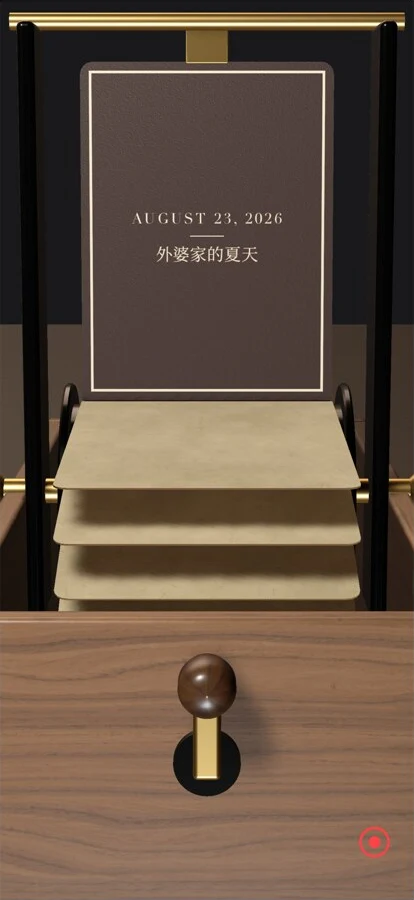
Trim the reel to choose where it starts and where it ends. Title it, and the line is printed on the first header card, under the date the photo was taken.
Every reel you print stays on a shelf in the app, next to the ones people give you.
Papers
Four papers.
The same reel can be printed on another paper at any time, and back again. The cut, the title and the pictures stay as they are; only the print changes.
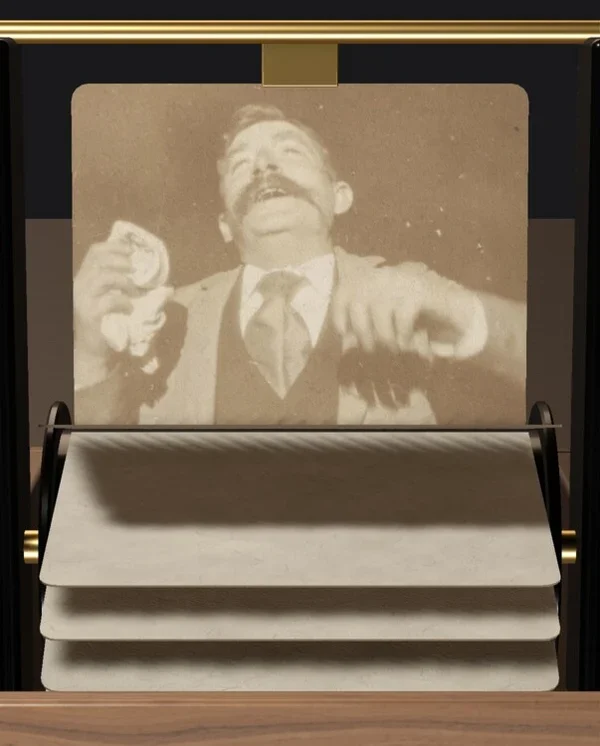
Matte colour paperThe photo’s own colours, on a matte surface.
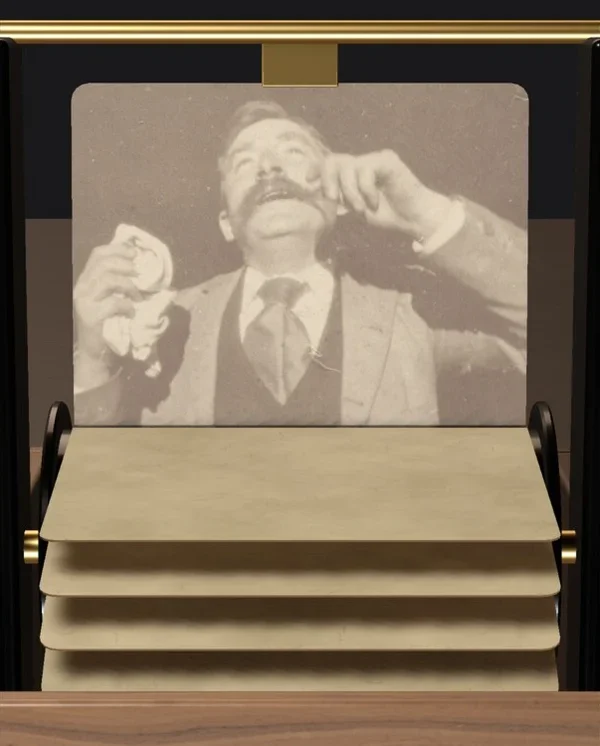
Albumen silver paperThe warm brown of a print of the 1890s.
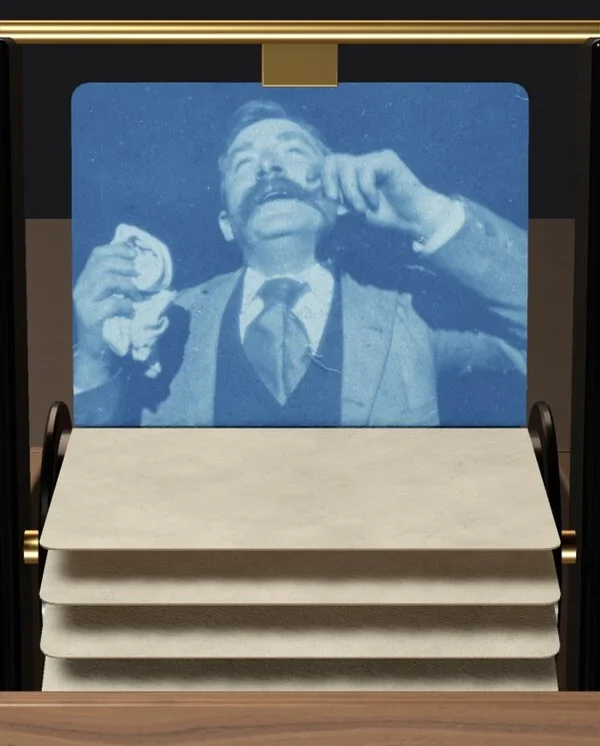
CyanotypePrussian blue and white.
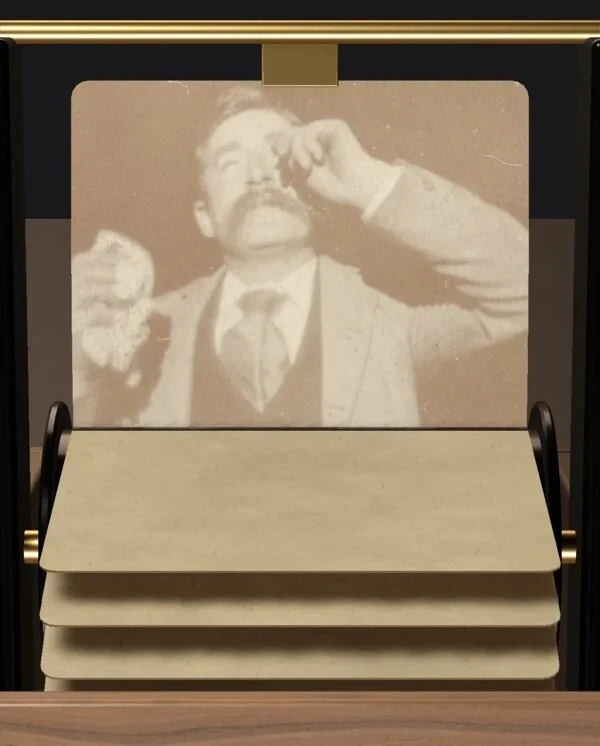
Hand-tinted photographA pale print with colour brushed on.
Stands
Three stands.
The stand is the frame that carries the stop bar, the case under it and the crank on its front. Change it, and the same reel turns in another machine.
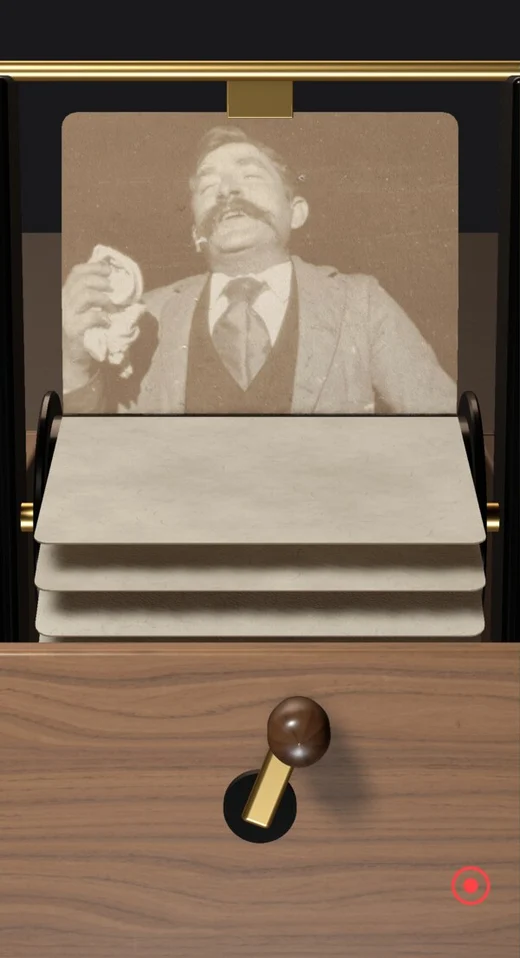
Black iron and walnutBrass bar, walnut case and knob.
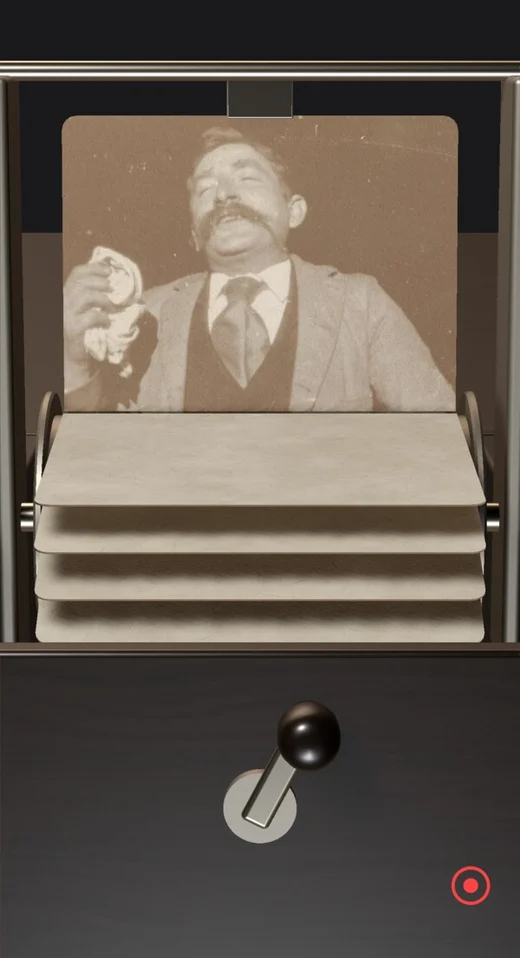
Nickel and ebonyNickel bar, black case and knob.
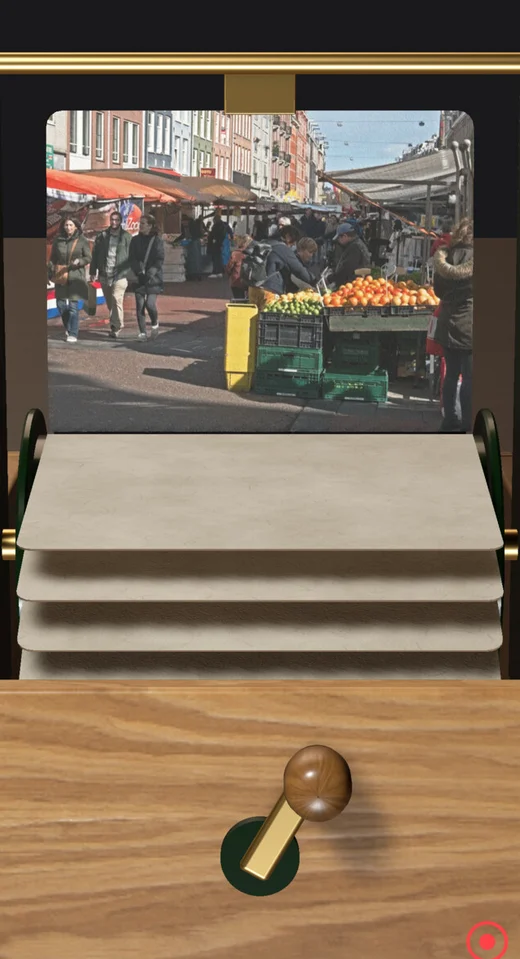
Green iron and oakDark green frame, pale oak case.
Share
A film, or the reel itself.
The red button films the reel as you turn it. The video keeps your pace, slow where you slowed and held where you stopped, with the sound of the cards: 1080 × 1920, 60 frames a second, up to 30 seconds, and no watermark.
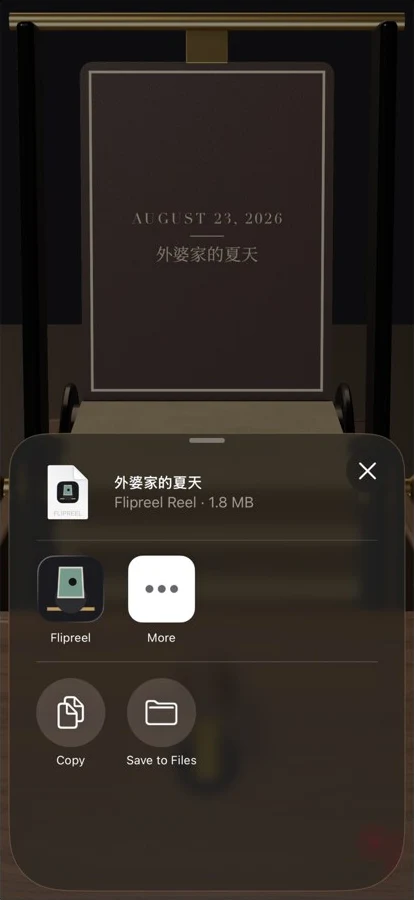
Or send the reel. It is packed as one .flipreel file of a few megabytes and handed to the share sheet, so it can go from one phone to the one beside it with no network at all. Opened in Flipreel, it goes on the shelf, ready to turn.
A reel you were given can be printed on another paper. Its cut and its title stay as they were sent.
The sample reel
One reel comes in the box.
In the first days of January 1894, in Edison’s Black Maria studio, W. K. L. Dickson filmed Fred Ott taking a pinch of snuff and sneezing. It was deposited for copyright on 9 January as a photograph: one sheet of 45 frames. That is exactly a reel.
Fred Ott’s Sneeze is on the shelf when the app is first opened, and it is the reel in the machine at the top of this page.
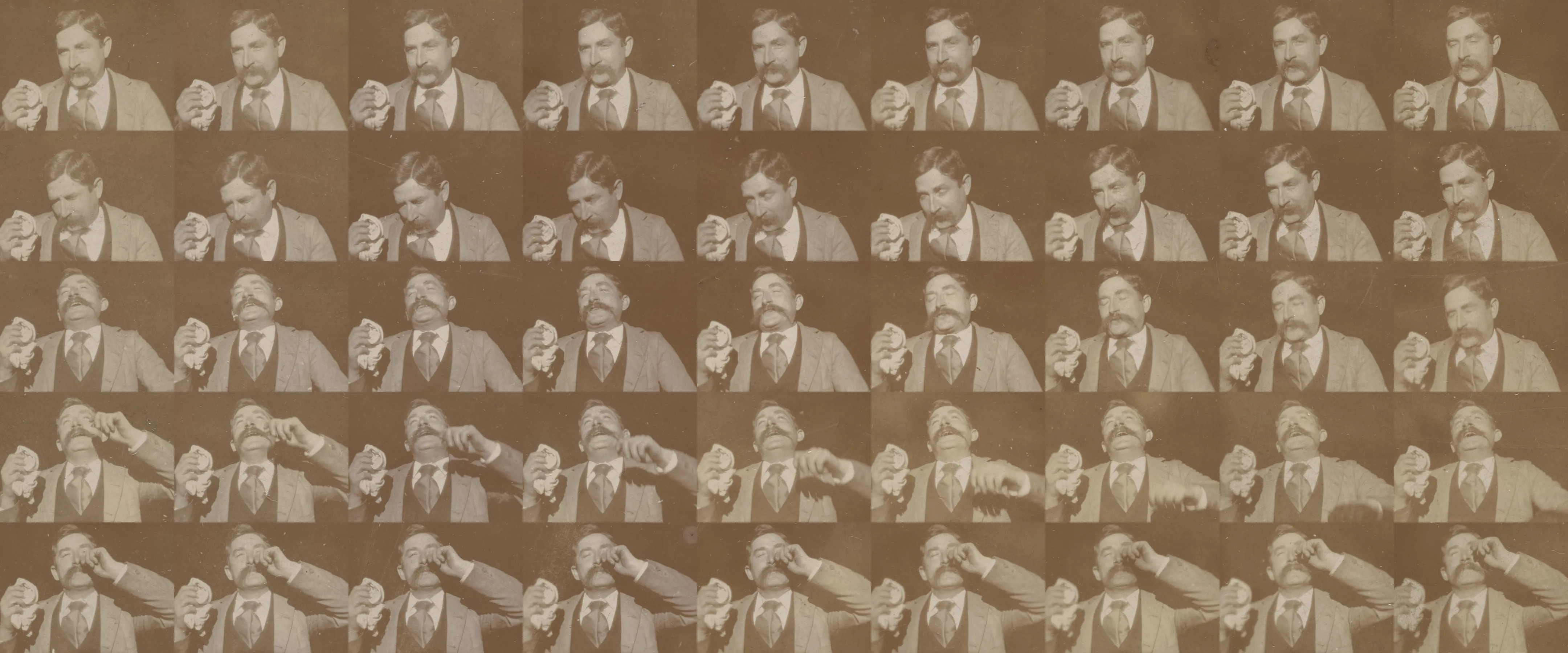
Edison kinetoscopic record of a sneeze, W. K. L. Dickson, 1894. In the public domain. From the Library of Congress, Prints & Photographs Division, LC-DIG-ppmsca-13462.
Later
Planned, and not in 1.0.
What this page describes is 1.0. These come after it.
- More papers and stands
- Unlocked with a single purchase, once. No subscription.
- Gift wrapping
- A reel you send arrives wrapped, to be opened.
- More languages
- 1.0 is in English.
Notes
FAQ
For support, email
contact@rubycat.coThe app has no accounts, ads, analytics or tracking. It sends nothing over the network, and it cannot read your photo library.
Read the privacy policy- Does it need access to my photos?
- No. The photo picker is the system’s own and runs outside the app. Flipreel receives the one Live Photo you pick and nothing else. If you save a film to Photos, iOS asks once whether Flipreel may add to your library; that does not let it see what is there.
- Does it use the network?
- Not on its own: there is no server and no account, and the app sends nothing. If the Live Photo you pick is kept only in iCloud, iOS fetches it from Apple. A reel leaves the phone only when you send it, through the share sheet.
- Where are my reels kept?
- On your phone, on the shelf in the app. Swipe one to delete it; the app asks first. They are not synced anywhere.
- Can someone without the app see my reel?
- Send them the film: it is an ordinary video. The
.flipreelfile opens only in Flipreel. - Does the header card say where the photo was taken?
- No. It carries the date and the line you wrote, and no location.
- Can I turn it backwards?
- The crank turns back freely, with a click from the ratchet, but the cards only fall one way, as they do on the real machines.
- Does it sound with the silent switch on?
- No. It follows the silent switch, and you still feel each card.
- Does it respect Reduce Motion?
- Yes. With Reduce Motion on, the blur of cards at a fast crank is turned off.
- Is there an iPad version?
- Not in 1.0. Flipreel is for iPhone, held upright.