Hand crank · stepped drum · 8 × 6 × 11
Stepdrum
A hand-cranked mechanical calculator for iPhone.
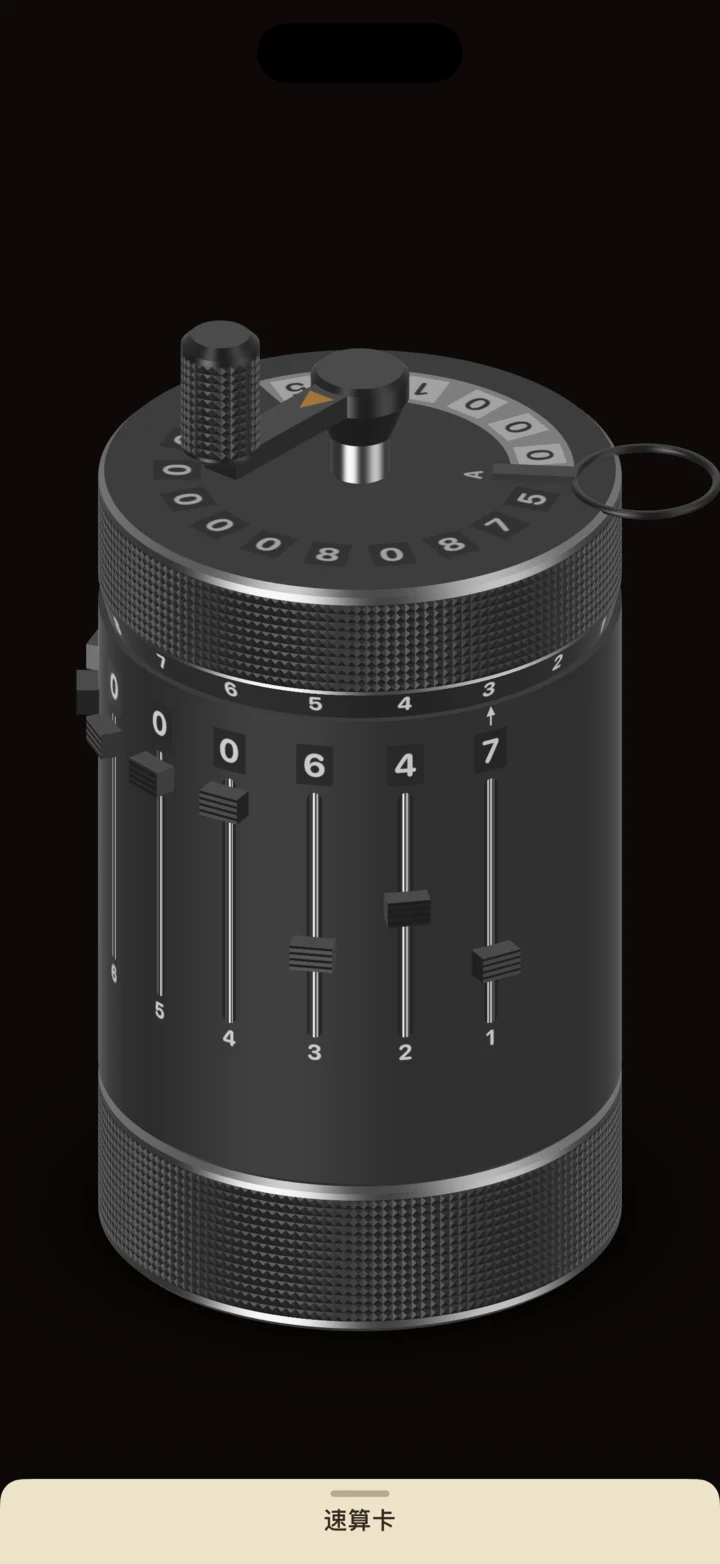
A tribute to the 1948 hand-held stepped-drum mechanical calculator: a knurled black aluminium body, eight sliders, a ring of number windows and a crank on top, at its real size. Set a number, turn the crank, and the stepped drum inside works the answer out a tooth at a time.
In development · iPhone, iOS 26 · Stepdrum is a working title
Turn one on this page firstTry the principle
Setting 647 · counter 0 · result 0
Carriage at place 1
Drag a column’s gear up or down to set its digit, then turn the crank clockwise, or tap it for a whole turn. Each turn adds the setting to the result; with the crank lifted it subtracts, and the carriage moves the result along by a place. This is the page’s diagram of the principle, the drum unrolled flat. It is not the app, it is not to scale, and it is silent.
The machine
A machine in your palm, not a calculator in a metal skin.
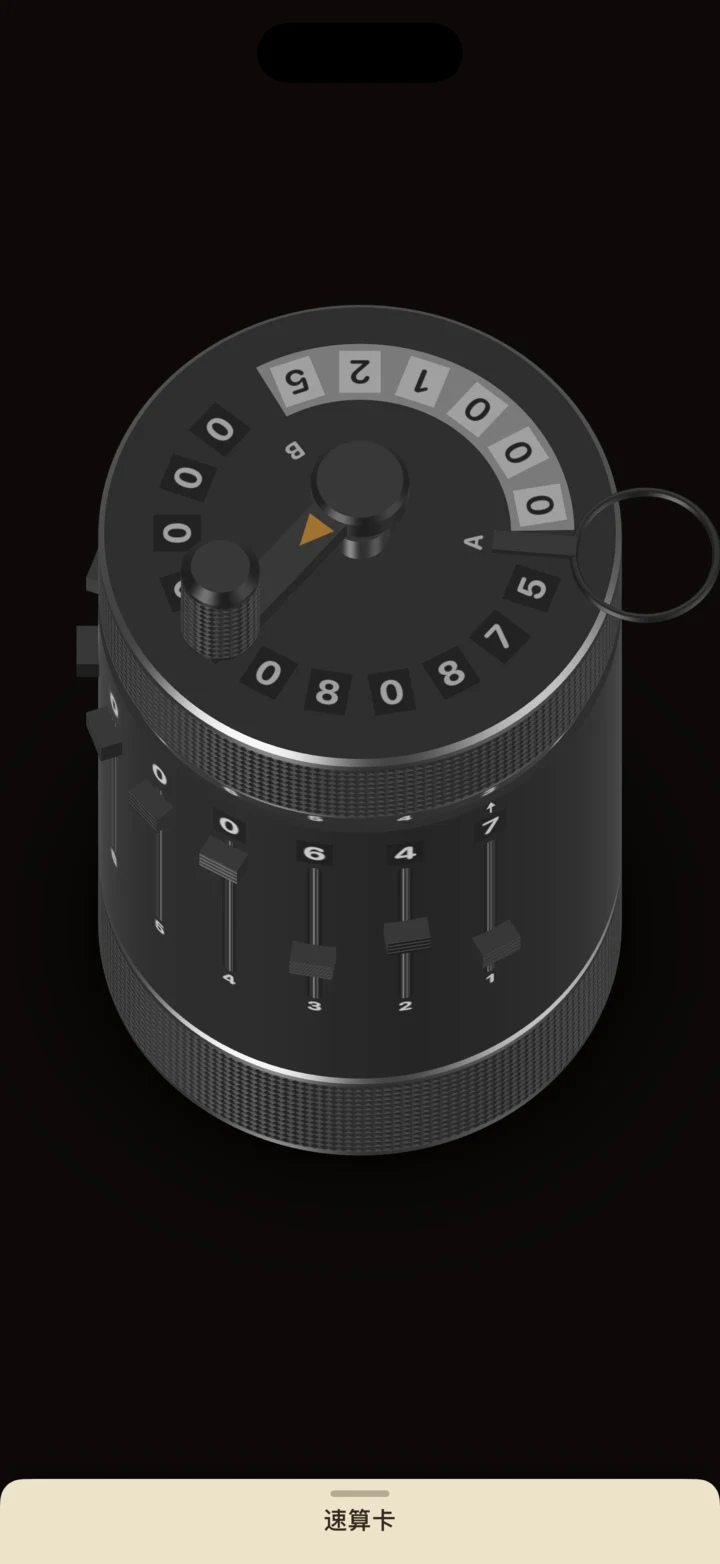
Stepdrum is the Type I: eight setting sliders down the front, and on top a ring of seventeen number windows, eleven black for the result and six white for the counter. The body is 53 mm across and 85 mm high, and the app draws it at that size.
You work it as the machine is worked. Slide a column to set a digit. Lift the knurled carriage ring and turn it to one of six places. Sweep the clearing lever round the top. Turn the crank clockwise for a turn of addition; at its stop, lift it a notch and the turn subtracts. Drag the grip ring at the bottom to turn the machine round, and tip the phone toward you to look down on the dials.
There is no = key, and nothing is worked out behind the scenes: each number wheel stands where the crank’s angle puts it. Stop half-way and the wheels stop half-turned. Drag the crank to count the teeth, or tap its head and it goes round once.
The locks are real. The crank will not turn backward, and while it is off its stop the sliders and the carriage will not move. Push anyway and you get one dull knock, in the hand and in the ear, not a message.
Every click is made as the teeth meet, from the crank’s angle: an empty turn is a light ratchet, a full one a run of teeth. There are no recordings in it.
- Setting · counter · result
- 8 × 6 × 11 digits
- Carriage
- 6 places
- Body
- 53 × 85 mm, life size
- Device
- iPhone · iOS 26
Inside
Twist the shell, and it turns to glass.
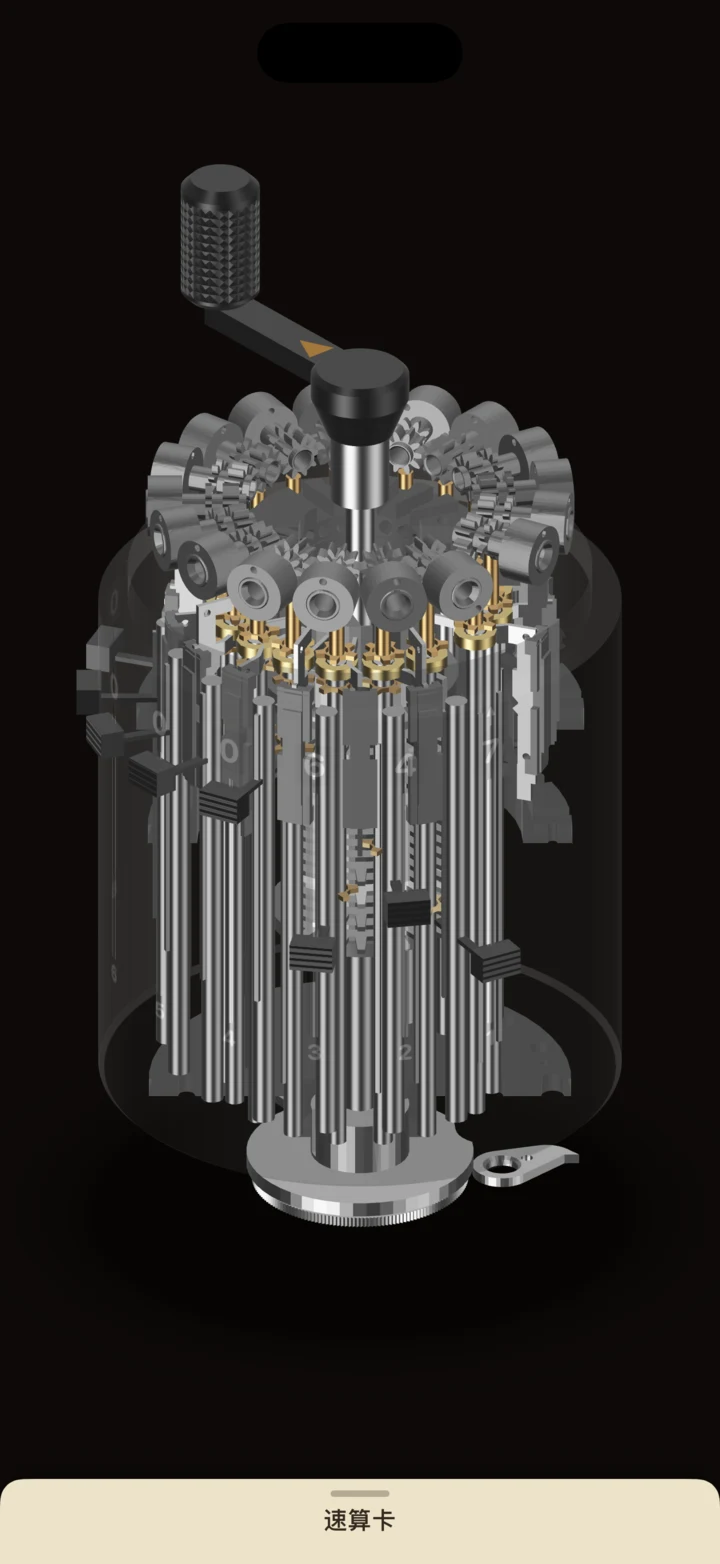
Turn the shell with two fingers and it clears. Inside is the movement, about 170 parts: the stepped drum on the crank’s shaft, a setting shaft for each column, the transmission shafts that take each column’s turning up to its number wheel, and the carry levers.
This is the whole idea of the machine, and you can see it. A slider moves a small gear along its shaft, and where the gear stands decides how many of the drum’s teeth meet it as the drum goes by: none at 0, nine at 9. The column you are setting is lit.
With the shell clear, the crank goes slowly: three turns of your finger make one of the crank, and a tapped turn takes four seconds, long enough to watch a carry pass from one wheel to the next.
The movement is modelled to show how the machine works. Its details have not been checked against the maker’s drawings.
The speed card
Six sums, to learn it by hand.
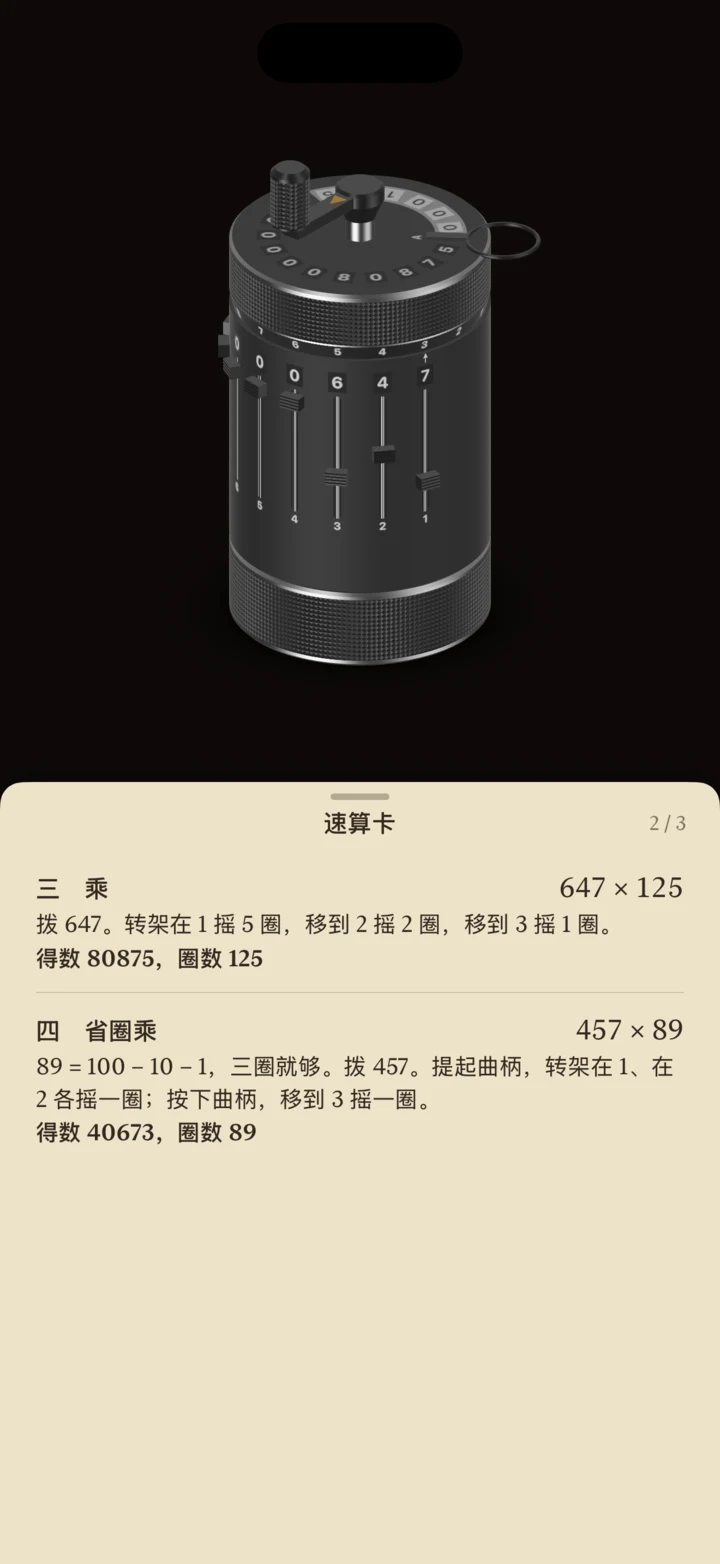
A card pulls up from the bottom edge of the screen: three folds, six worked examples, from adding two numbers to taking a square root. Each says what to set, where to put the carriage and how many turns to give.
The machine goes on working above the card at half size, so you can follow a line with the crank and read the answer off the wheels. The fourth example is the one to show a friend: 89 is 100 − 10 − 1, so 457 × 89 takes three turns, two of them with the crank lifted.
- Add
- 237 + 419 = 656
- Subtract
- 139 − 78 = 61
- Multiply
- 647 × 125 = 80875
- Multiply, fewer turns
- 457 × 89 = 40673
- Divide
- 1728 ÷ 12 = 144
- Square root
- √1369 = 37
Also planned for 1.0
What is still to be built.
This page describes the 1.0 we are working toward. The machine, its glass shell and the speed card above are built, and are being tried on real phones. What is listed here is planned and not built.
No pictures yet: none of this exists to photograph.
- Type II
- The larger machine, with eleven setting columns.
- The canister
- The screw-lid canister a machine is kept in.
- A collection
- More than one machine, and a way to change between them.
- iPad
- The pictures above are of iPhone, held upright.
- A first-run guide and more languages
- Including the speed card, which is in Chinese so far.
- A one-time purchase
- One complete black Type I is free, with no subscription and no ads. What a one-time purchase adds, and its price, are not decided.
Notes
FAQ
For questions, email
contact@rubycat.coThe app has no server, no accounts and no ads, and it collects no data.
Read the privacy policy- When is it out, and what will it be called?
- There is no date. Stepdrum is a working title, a translation of Staffelwalze, the stepped drum; the name it will have on the App Store is not settled.
- Is it free?
- One complete black Type I is free, with no subscription and no ads. Whether there is a one-time purchase beyond that, and what it holds, is not decided.
- Is it a calculator app?
- No. It will not put a line of electronic digits on the screen to read the answer for you, and it will not work a sum out in one tap and play the crank afterwards. There are no scores, levels or streaks either.
- Why won’t a slider move?
- The crank is off its stop. Bring it home and the sliders, the carriage and the crank’s lift are free again. In this one place the app locks more than the original does: its manual only tells you to bring the crank home first.
- Is it really life size?
- iOS does not tell an app how big its screen is, so the app looks the size up by iPhone model. On a model it does not know, the body takes four-fifths of the screen’s width.
- How do I divide?
- With the reversing lever on the back of the machine: drag the grip ring to turn the machine round. The speed card’s fifth example walks through it.
- Whose machine is it?
- It is a tribute to the 1948 hand-held stepped-drum mechanical calculator. It carries no maker’s lettering.